
Thesis
The frontier AI labs spent the early part of the 2020s feeding models the internet. Cutting-edge language models in 2025 were trained on roughly 15 trillion tokens of text, and that supply has largely run dry. The harder problem is that the data needed to teach a model physics or chemistry was never on the internet to begin with. Whether a given compound superconducts at a given temperature, or how much energy it takes to assemble its atoms into the desired structure, is knowable only by running an experiment. Most such experiments have never been run.
Even the data that does exist on such questions represents a biased sample: researchers rarely publish negative results, so a model trained on published syntheses learns from successes stripped of the failures that would teach it where the boundaries are. For materials and the physical sciences, the training data does not exist in any form that a model can learn from. The technique that produced the reasoning models that exist in 2026, namely high-compute reinforcement learning against a verifiable reward, requires a reward signal to optimize against. In chemistry and physics, that signal can come from reality itself. For example, synthesizing a material and measuring its properties and nature could return an unambiguous verdict on whether the hypothesis was right, with no human labeler and no simulator approximation in the loop.
Two emerging developments are making such an approach possible for the first time. Robotic powder synthesis, which uses automated systems and AI to mix, grind, and characterize precursor powders into new materials, has become cost-effective and repeatable enough to operate at high throughput. Meanwhile, the same simulation and language-model tooling that the AI labs built for other purposes has reached a level of sophistication that enables it to propose hypotheses, run quantum-mechanical calculations, and interpret the results. This effectively removes the bottleneck imposed by human involvement on some kinds of scientific research.
Periodic Labs is building AI scientists paired with autonomous laboratories that run experiments end-to-end, with the discovery of a high-temperature superconductor as its stated north star. The company was founded in 2025 by Liam Fedus, a co-creator of ChatGPT and former VP of research at OpenAI, and Ekin Doğuş Çubuk, who led the materials-discovery work behind Google DeepMind’s GNoME. Its first laboratory is built around powder synthesis, the cheap and general method by which a large fraction of solid-state materials are made. The company’s strategy is to start with a model trained to design a superconductor in-house and generalize that model into a commercial intelligence layer for every advanced-manufacturing firm whose researchers manually run read-simulate-experiment loops today.
Founding Story

Source: Periodic Labs
Periodic Labs was founded in May 2025 in San Francisco by Liam Fedus and Ekin Doğuş Çubuk, Prior to founding the company, the two had known each other for years, catching up periodically and, by Çubuk’s account, repeatedly ending up in conversations about quantum mechanics and superconductivity, without ever expecting to work on physics together.
Fedus spent part of his career at the center of the field of language models. At Google Brain, he co-authored the Switch Transformer, the 2021 work that scaled a mixture-of-experts architecture past 1 trillion parameters. He then moved to OpenAI, where he became a co-creator of ChatGPT and rose to VP of research, working on the post-training methods that turned a raw language model into a usable assistant. The reinforcement-learning-from-human-feedback recipe Fedus helped build for ChatGPT is the same recipe Periodic intends to run, with one substitution. Where ChatGPT optimized against a reward model trained on human preferences, Periodic optimizes against experiments. As Fedus put it, “ultimately, science is driven against experiment in the real world,” so “we need to have experiment in the loop, and that becomes our reward function for our agents.”
Çubuk, meanwhile, holds a PhD in physics from Harvard and has spent much of his career proving that machine learning could move materials discovery. As a research scientist at Google DeepMind, he led the work behind GNoME (Graph Networks for Materials Exploration), which in 2023 used deep learning to predict 2.2 million new crystal structures, including 380K that the model identified as stable candidates. GNoME was a demonstration that simulation and learning could expand the known materials space by an order of magnitude, but it stopped at prediction. The gap that Periodic Labs was founded to close is between a predicted material and a synthesized one, the step where most predictions fail and where, in Çubuk’s framing, “the experimental data we want actually doesn’t exist.”
The decision to found Periodic Labs stemmed from a shared observation that two trend lines were converging. On the one hand, reasoning and high-compute reinforcement learning were making language models dramatically more capable. On the other hand, materials science was developing its own scaling laws in both simulation and experiment that, to the founders, looked like the same principles at play in machine learning.

Source: Google DeepMind
The thesis of Periodic Labs is that the missing ingredient for scientific AI is establishing a tighter automated loop with limited human intervention, i.e., a model that can read the literature, run the simulation, propose the experiment, and then actually run it, learning from the result the way a human researcher does. Çubuk’s framing is that even the smartest humans iterate many times before discovering anything, and that a language model without the ability to iterate against reality “won’t discover science.”
Product
Closed Experimental Loops
Modern language models are trained in stages. A base model learns from internet-scale text. Then, post-training, through a mix of supervised examples and reinforcement learning against a reward function, shapes that base into something useful. For ChatGPT, the reward function was trained on human preferences: humans judged which of two responses was better, over and over, until that signal could be optimized against. The limitation Periodic Labs starts from is that this entire pipeline is digital. It teaches a model what humans have already written down, but for frontier science, the most valuable facts have not been written down because the experiments have not been run.
Periodic’s product is an attempt to replace the human-preference reward with a physical one. The company describes building “a physical reward function” where “the ground truth is the experiment” and “nature is our RL environment.” In practice, that means a loop with several stages that the company is automating: a model reads the relevant literature, runs quantum-mechanical simulations and theoretical calculations to narrow candidates, synthesizes the most promising materials in a physical lab, characterizes the result, and feeds the measured outcome back as the signal that updates the model. When a simulator’s prediction diverges from what the furnace produces, the experiment wins and the system error-corrects toward reality.
Powder-Synthesis Lab
Source: Google DeepMind
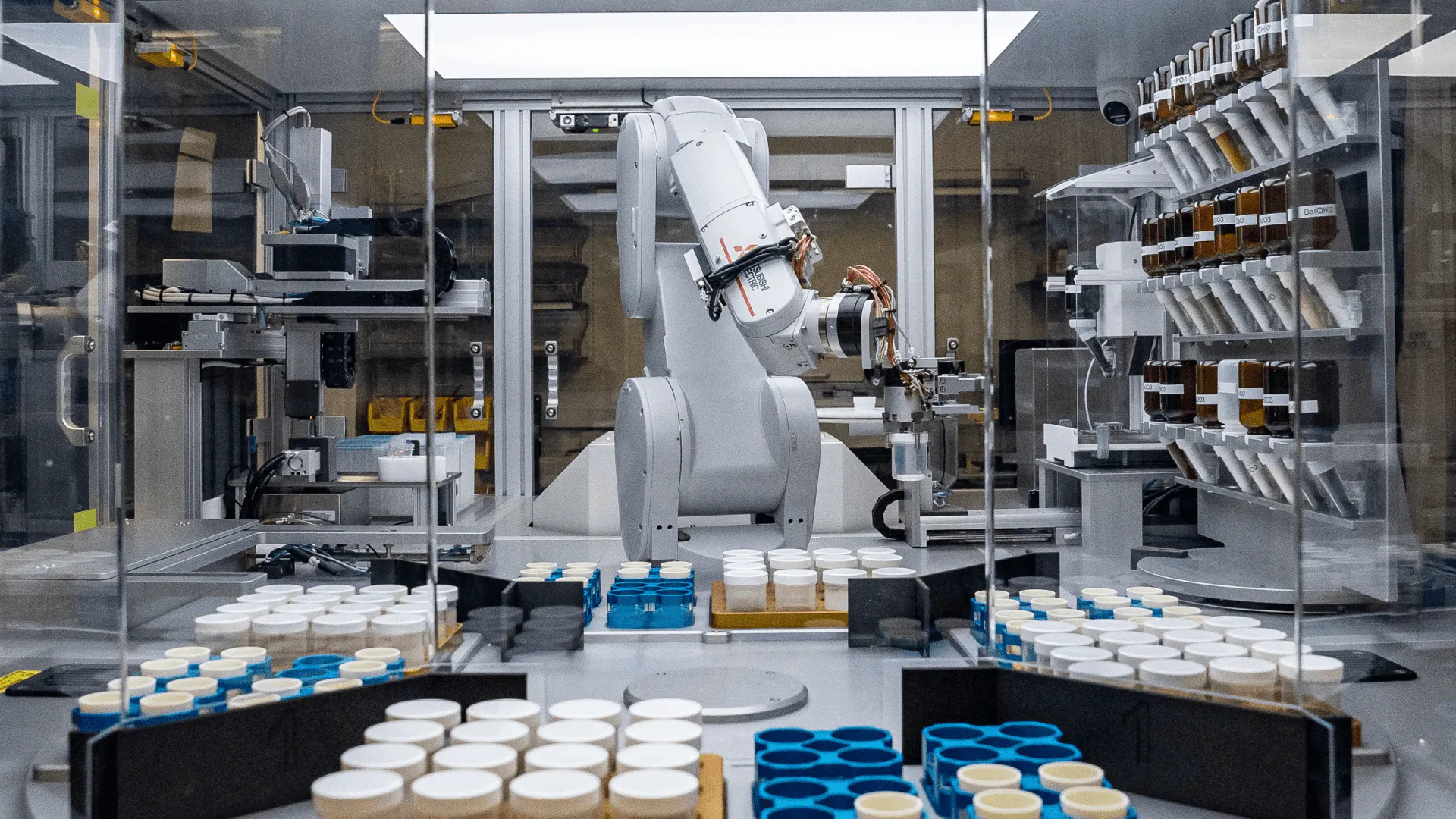
Periodic’s first laboratory is built around powder synthesis, which the founders chose deliberately as a starting point because it is both fundamental and cheap to automate. The method is to take powders of existing materials, mix them in chosen ratios, and heat them to a target temperature until they react into a new material. A large fraction of solid-state materials, including superconductors and magnets, can be made this way. Crucially for an automated lab, the physical operations are simple enough for a robot. Çubuk has compared the required dexterity to the coffee-making robots already deployed in airports: mixing powders and loading a furnace do not demand frontier robotics, which makes high-throughput, low-cost experimentation feasible today rather than after a decade of hardware progress.
The company’s argument is that the experimental data it needs to train on either does not exist or is too noisy to be useful. One example the founders cite is formation enthalpy, the energy required to assemble atoms into a target structure, whose reported values in the literature are so noisy that a model trained on them is not predictive enough to guess the next compound. In addition, negative results compound the problem. Because failed syntheses are rarely published, the literature systematically omits the information a model would most need to learn the boundaries of what works. By generating its own high-throughput, high-quality data, including the negative results, Periodic intends to train on a signal that exists nowhere else.
Mid-Training
The mechanism by which Periodic intends to turn lab data into a usable model is what the field calls mid-training: continuing to pre-train a model by injecting new knowledge that was not in its original training set, before the usual post-training steps. In Periodic’s case, the injected knowledge is its own simulation and experimental data, from low-level descriptions like crystal structures to higher-level accounts of how a given material was made. The bet is that a model saturated with physical-science data it could not have learned from the internet becomes useful not only for the company’s internal superconductor goal but for any customer running a similar read-simulate-experiment workflow. As the founders describe it, progress toward their internal physics goals directly improves the models that serve customers, because the customers’ R&D researchers do “very similar workflows” of reading literature, running calculations, and attempting experiments.
Customer
Periodic’s commercial entry point is the set of advanced-manufacturing and physical-science companies whose R&D depends on materials iteration. The company has framed its commercial ambition as becoming “an intelligence layer for all these teams to accelerate their workflow and start reducing their iteration time,” positioning the product as an accelerant for in-house researchers and engineers rather than a replacement for them. The natural early customer is a firm whose researchers already run the read-literature, run-simulation, attempt-experiment loop by hand, and whose competitiveness turns on how fast that loop runs.
As of March 2026, Periodic had reportedly secured early customers in the semiconductor industry, where the demand for new materials and faster discovery cycles is constant, and was already generating revenue. Semiconductor and adjacent advanced-materials firms run the kind of materials-iteration problem Periodic’s models are trained on, and they have both the budgets and the urgency to pay for a faster loop. The founders have also pointed to a structural reason these industries are addressable: the most recent AI techniques have not yet diffused into them, so a firm may have rich proprietary experimental data but lack the methods to exploit it.
Market Size
There is no single total addressable market for an “AI scientist,” because the product cuts across every industry whose progress depends on discovering or improving materials. Periodic investor a16z, in announcing its investment, framed the addressable market as all the industries Periodic’s work touches, representing “roughly $15 trillion of global GDP.” One reason for this is that materials underpin a number of large industries, including semiconductors, energy, defense, and manufacturing, and a tool that compresses the materials-discovery cycle has a claim to the value created across all of them.
Global research and development spending was estimated at $2.9 trillion in 2024. Of this, corporate R&D represented a historic high of nearly $1.3 trillion. Periodic’s product is aimed at the materials-and-chemistry portion of that spend, where the loop it automates (hypothesize, simulate, synthesize, measure) is the daily work of industrial R&D. Even a small share of corporate physical-science R&D, redirected from manual iteration to an automated loop priced on the value of faster discovery, would represent a large business.
The near-term serviceable market is narrower and concentrated in industries that already run materials discovery at scale and face competitive pressure to accelerate it: semiconductors, advanced manufacturing, batteries and energy storage, magnets, and the defense industrial base. These are the customers that Periodic can reach with its first lab.
Competition
Startups
Lila Sciences: Lila Sciences was founded in 2023 inside Flagship Pioneering and is pursuing “scientific superintelligence” through autonomous AI labs spanning life sciences, chemistry, and materials. The company raised a $200 million seed in March 2025, then closed a $350 million Series A in October 2025 at a valuation of over $1.3 billion, with investors including Nvidia’s venture arm, bringing total funding to $550.7 million. Lila’s broader, multi-domain scope contrasts with Periodic’s deliberate focus on solid-state physics and a single north-star problem.
Radical AI: Radical AI, founded in 2024, is the closest analog to Periodic in both approach and timing: it pairs AI-driven prediction, high-throughput computational screening, and robotically operated labs to discover new materials, and it has established autonomous materials-science labs at the Brooklyn Navy Yard. Radical AI raised a $55 million seed round in July 2025, led by RTX Ventures with participation from Nvidia’s NVentures. A month later, it was awarded an AFWERX Direct-to-Phase II contract from the US Air Force to accelerate discovery of high-entropy alloys for hypersonic flight. Where Periodic’s declared north star is superconductivity, Radical AI’s early flagship application is defense alloys, a difference in commercial entry point more than in method.
Incumbents
Google DeepMind: DeepMind is an incumbent whose work Periodic Labs is built to extend rather than compete directly against. The GNoME project, which Çubuk led, predicted 2.2 million new crystals and 380K stable candidates in 2023, and DeepMind continues to invest in AI-for-science across materials, biology, and weather. Its advantage is that it has access to more compute than almost any other company and its pedigree with simulation. Its disadvantage, relative to a focused startup like Periodic Labs, is that materials discovery competes for attention inside a far larger research agenda within DeepMind overall, and that GNoME stopped at prediction rather than closing the synthesis loop Periodic is targeting.
Microsoft: Microsoft competes through its research division rather than a standalone entity, most visibly with MatterGen, a generative model for inorganic materials design released in 2025, alongside the broader Azure Quantum Elements effort to put materials simulation in the cloud. Microsoft’s reach into enterprise customers and its cloud-scale simulation infrastructure are real advantages, but its work so far has centered on the computational prediction layer rather than on operating physical autonomous labs, leaving the experimental loop closure that defines Periodic’s thesis comparatively open.
Periodic’s differentiation from Microsoft lies in the fact that it possesses a founding team that built the state of the art for both the language model and materials discovery, a deliberate focus on a single hard physics problem rather than a broad platform, and a commitment to closing the full physical loop in-house rather than stopping at prediction.
Business Model
Periodic has not publicized a pricing model. Its founders, however, have been explicit that the company is meant to be a commercial entity, not a research institute, and that the commercial success funds the science rather than the reverse: “technology and capital are intertwined. We’re going to be able to maximally accelerate science if this is a wildly successful commercial entity.”
The near-term revenue model implied by the founders’ framing and the early customer reporting is to sell the model and its loop as an intelligence layer to advanced-manufacturing and physical-science firms, accelerating their internal R&D. The mechanism is mid-training: ingesting a customer’s or an industry’s proprietary simulation and experimental data into the model so it can serve that customer’s specific materials problems, while the company’s own superconductor work continually improves the underlying model. The reported semiconductor-industry traction and revenue are consistent with this enterprise-services or model-access shape, though the exact form (per-seat access, contract research, a licensing arrangement on discoveries, or some combination) has not been disclosed.
Traction
Periodic emerged from stealth in September 2025. As the company is still less than 12 months old, its fundraising and the investor interest behind it remain an important traction signal. The $300 million seed round in September 2025 was remarkably large for a seed round, with some reporting indicating it set off a “VC frenzy”. The round was backed by investors including Andreessen Horowitz, DST Global, Nvidia, Accel, Felicis, and angels including Jeff Dean, Eric Schmidt, and Jeff Bezos.
However, there are other indications of traction, including reports that Periodic had secured early customers in the semiconductor industry and, unlike many of its peers, was already generating revenue. The company has also assembled a scientific advisory board spanning the relevant fields, including superconductivity experimentalist Zhi-Xun Shen and theorist Steven Kivelson of Stanford, synthesis expert Mercouri Kanatzidis of Northwestern, and Nobel laureate chemist Carolyn Bertozzi.
Valuation
Periodic has raised one disclosed round: a $300 million seed that closed in September 2025 at a post-money valuation reported at $1.3 billion. The round was led by Andreessen Horowitz with participation from DST Global, Nvidia, Accel, and Felicis.
As of March 2026, Periodic was reported to be in talks to raise $500 million in a new round, which would value the company at $7 billion. As of June 2026, that round had not been confirmed as closed. If it closes near those terms, it would represent roughly a 5x step-up over the seed in about six months, on the strength of early commercial traction rather than a demonstrated scientific breakthrough.
Source: Koyfin
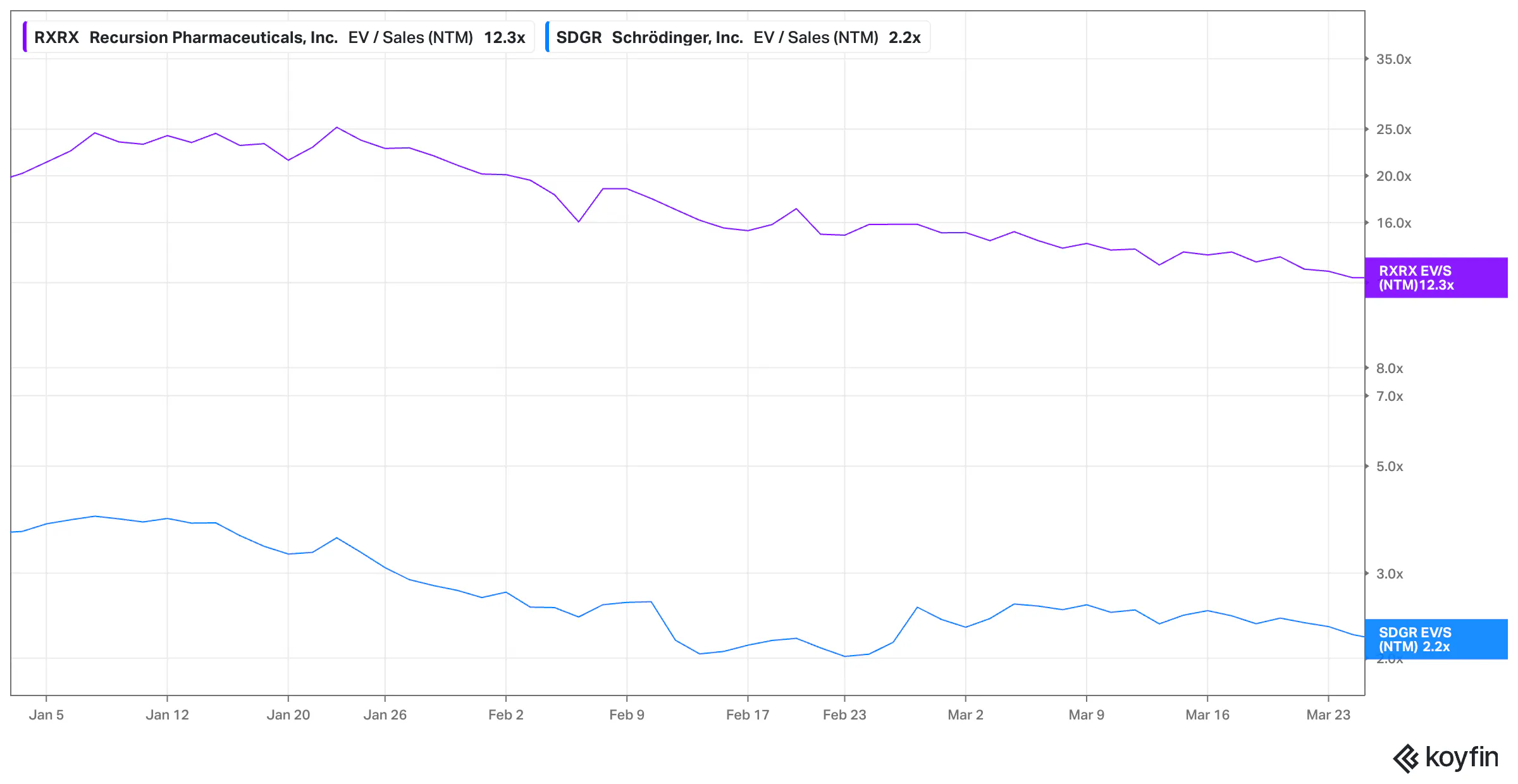
There are no perfect public comparables for a pre-breakthrough AI-for-science lab, but the closest listed proxies sit in AI-driven drug and materials discovery and offer a sobering frame for the private marks. Recursion Pharmaceuticals had a market cap of $1.7 billion against $66 million in trailing-twelve-month revenue as of June 2026. Schrödinger, whose physics-based simulation software is conceptually adjacent to Periodic’s computational layer, carried a market cap of $1.1 billion against full-year 2025 revenue of $256 million as of the same date. Both trade at a fraction of Periodic’s reported private valuation while generating real revenue.
Key Opportunities
Advanced Manufacturing Intelligence Layer
Periodic’s largest near-term opportunity is the one the founders point to directly as turning the model trained on its internal physics problems into a commercial accelerant for every advanced-manufacturing firm running the same loop by hand. The opportunity is that industries often hold rich proprietary experimental data but have not adopted the latest AI techniques, so a vendor can ingest a customer’s data during training and deliver a faster discovery loop. If even a modest slice of the nearly $1.3 trillion in annual corporate R&D shifts toward this model, the services business alone justifies a large company, independent of whether the superconductor north star is ever reached.
Breakthrough Materials
The higher-variance opportunity is value capture on a discovery itself. The founders argue that a high-temperature superconductor is less a single goal than a tree of sub-goals (autonomous synthesis, autonomous characterization, model-run simulation), each valuable in its own right, so that the path to the north star produces useful intermediate results even if the ultimate target proves elusive. A novel superconductor, magnet, or battery chemistry would carry economic value that would likely exceed something like a software subscription business, and because Periodic owns the loop end to end, it is positioned to capture more of that value than a pure tooling vendor.
Compounding Data Advantage
Because the experimental data Periodic generates exists nowhere else, every cycle of the loop widens a proprietary dataset that competitors cannot buy or scrape. If the company sustains its synthesis throughput, the model trained on that data, including the unpublished negative results, should improve in ways that are difficult to replicate, creating a moat that strengthens with use rather than eroding. The opportunity is to convert a temporary talent-and-capital lead into a durable data advantage before equally well-funded competitors close the gap.
Key Risks
Commercial Timeline Demands
The central risk is that the loop Periodic Labs purports to build does not produce commercially meaningful discoveries fast enough to outrun the capital it consumes. High-temperature superconductivity has resisted the field for decades; the best ambient-pressure result the founders cite sits around 135 Kelvin, and progress toward room temperature has been halting and, at times, marred by retracted claims elsewhere in the field. Periodic has acknowledged that its north star represents a distant and difficult-to-reach goal. The danger is that an autonomous lab is expensive to run, and a multi-year stretch without a definitive result would make each subsequent round harder to justify even if the underlying approach is sound.
Uncertain Generalizability
Periodic’s commercial thesis depends on a model trained on one class of problems transferring to others: that progress on superconductivity improves the model’s usefulness on a customer’s unrelated materials problem. The founders acknowledge this is an open research question, noting that how well a system generalizes from, for example, superconductivity data to magnetism data, and whether that transfer extends to more distant domains like fluid mechanics, is uncertain. If generalization is weak, Periodic becomes a collection of narrow, separately built pipelines rather than a single compounding model, which would undercut both the data-moat and the intelligence-layer arguments and make the business far more capital-intensive to scale across industries.
Crowded Competitive Landscape
The same conditions that make this category attractive have drawn in deep-pocketed competitors on a compressed timeline. Lila Sciences has raised more total capital, Radical AI is pursuing a near-identical full-stack approach with early defense traction, and Google DeepMind and Microsoft bring compute and simulation resources no startup can match. All of them compete for the same scarce pool of researchers who can work across machine learning and experimental physical science, the exact talent Periodic treats as its core asset. A sustained bidding war for that talent, or a competitor reaching a credible scientific or commercial milestone first, would erode the pedigree-and-team advantage that underpins Periodic’s valuation more than any demonstrated result does.
Summary
Periodic Labs is betting that text can only take autonomous scientific discovery so far. Its founders built the language-model and materials-discovery state of the art at OpenAI and Google DeepMind, and they left to solve a problem that became increasingly clear to them: the data needed to teach a model physics and chemistry does not exist on the internet, and the only way to generate it is to run the experiments. By pairing AI scientists with autonomous powder-synthesis labs and treating nature as the reward function, the company aims to close the hypothesis-to-experiment loop, compounding into both a proprietary dataset and a commercial intelligence layer for advanced manufacturing, with a high-temperature superconductor as its north star.